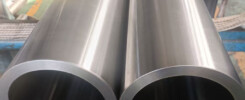
The bore of a heavy-duty hydraulic cylinder decides how well the whole machine performs. Every stroke, the piston, the seals and the oil film move against the inner surface of the tube. A small difference in that surface can change energy use, heat, and the working life of the cylinder. This article explains what Ra < 0.2 µm means, and how a high-precision honed tube improves efficiency and longevity.
What Ra < 0.2 µm really means
Ra is the average roughness of a surface. It is the most common way to describe how smooth a machined surface is, and it is defined in ISO 4287 (now updated as ISO 21920-2). Ra < 0.2 µm means the surface is very smooth: the average deviation of the surface profile is less than 0.2 micrometres, roughly one five-hundredth of a millimetre.
For a seal, this surface feels like polished glass. But it is not perfectly flat. A good honed bore keeps microscopic valleys that hold oil. That oil film is what actually separates the seal from the metal.
Here is a point that many buyers miss: Ra alone is not enough. Seal manufacturers also specify Rz (peak-to-valley height) and Rmr (the material contact ratio, or the “plateau” area). For dynamic sealing surfaces, a common recommendation is Rmr of 50–70% with a low Ra. So the real goal of high-precision honing is a plateau surface: smooth enough for low friction, with controlled valleys to hold lubrication. When you see “Ra < 0.2 µm” on a certificate, the underlying Rz and Rmr values matter just as much.
How it improves efficiency
- Lower friction. A smooth bore reduces friction between the piston, the seals and the tube. Less force is wasted inside the cylinder.
- Less heat. Friction turns into heat. Lower friction keeps the oil cooler, which slows oil degradation and reduces cooling demand.
- Smoother motion. A stable oil film helps the cylinder move steadily at low speeds. It reduces “stick-slip”, the jerky movement that hurts control.
- Better control. With less friction and less variation, the cylinder positions more precisely. This matters for presses, cranes and other load-sensitive machines.
How it extends service life
- Seals last longer. Seals are the most wear-prone parts in a cylinder. A rough bore acts like sandpaper on the seal lip. At Ra < 0.2 µm, abrasive wear slows down dramatically.
- Less internal leakage. When seals stay healthy, internal leakage stays low. The cylinder keeps its rated force and speed for much longer.
- Fewer wear particles. A smooth surface sheds far fewer metal particles into the oil. Cleaner oil protects the pump, valves and other components.
- Less downtime. Longer seal life and cleaner oil mean longer maintenance intervals. For heavy machines, fewer repairs directly lower the total cost of ownership.
A key insight: “smoother” is not always “better”
Some buyers assume the smoothest surface is the best. In practice, a bore that is too smooth (roughly below 0.1 µm) may not hold enough oil film. The seal can then run dry, overheat, and wear out faster. This is why the finishing process matters more than the Ra number alone. High-precision honing creates the right combination: a smooth plateau that carries the seal, plus valleys that store oil. Research on hydraulic cylinder barrels has found an optimum roughness around Ra 0.2 µm for many seal systems.
What to check when buying honed tubes
- The Ra value on the test certificate — and Rz / Rmr if the supplier provides them.
- The finishing process: conventional honing or skiving and roller burnishing.
- Material grade and hardness (for example E355, ST52 or equivalent).
- Dimensional tolerance, roundness and straightness.
- Consistency along the full length. A tube that meets Ra at both ends but not in the middle is a common hidden problem.
Summary
A high-precision honed tube is not a luxury for heavy-duty cylinders. It is a practical way to cut energy loss, protect seals, and extend service life. The best surface is not the smoothest one — it is the right profile, produced consistently along the whole bore. If you are specifying a cylinder or a replacement tube, these are the points worth discussing with your supplier.
Further reading
- Parker Hannifin — Heavy Duty Hydraulic Cylinders catalog — bores honed to a micro finish to minimize internal friction and prolong seal life
- Trelleborg Sealing Solutions — Hydraulic Seals catalog — surface roughness and Rmr recommendations for dynamic sealing surfaces